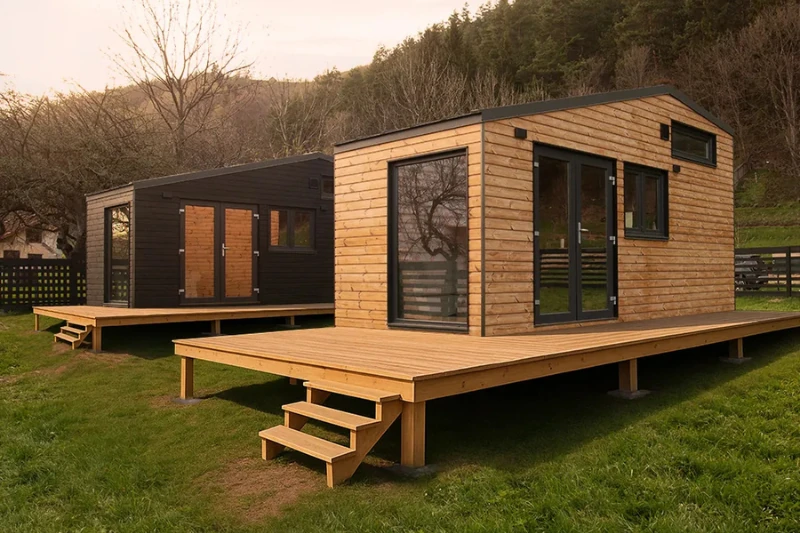
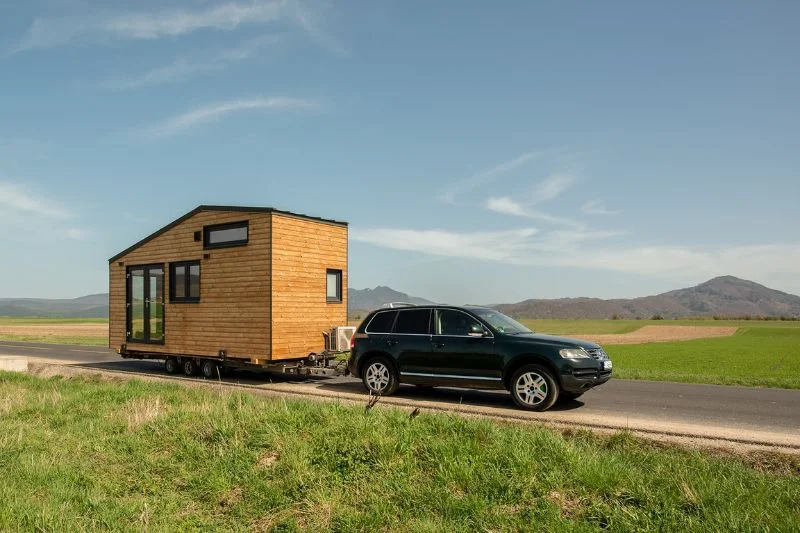
The Best Materials for a Tiny House. What We Use
The reasons behind our choice of high-quality construction materials.

Find out how a rainy experience in Verona taught us just how important construction materials are — and how they can make the difference between a successful investment and a costly mistake. Discover which materials we use in our tiny houses, as well as the ones we would never use, no matter the price.
Rain in Verona
In Verona, we stayed in a beautiful tiny house, painted a warm ochre — a tribute to the sunny city. The weather had cooled down, it was perfect, and we couldn’t wait to retreat into the tiny house’s small, welcoming space. And everything really was perfect — until the rain came down.
At first, the raindrops sounded almost poetic on the roof as we watched the green countryside through the panoramic window. The poetry ended rather quickly when water started making its way through the tiny house roof, and we learned the hard way — quite literally — what happens when the best construction materials aren’t used. And how a product that looks high-quality can turn out to be a major disappointment.
Verona made one thing very clear to us: the quality of the materials is not a detail. It is at the heart of a tiny house that needs to stand the test of time and withstand the elements. It can be the difference between comfort and discomfort, between success and failure. An investment that starts out as a smart decision — buying tiny houses for accommodation — can quickly turn into a nightmare if you choose a builder who cuts costs by cutting corners on quality.
At TinyKiwi, We Use the Best Materials for Our Tiny Houses
When we started our own tiny house business, we made quality a guiding principle in every decision we made. Choosing the right materials means durability, energy efficiency and, above all, safety. It means building for long-term success.
So, here’s what we use at TinyKiwi for our tiny houses (green checkmark) — and what we would never use under any circumstances (red X).
TINY HOUSE MATERIALS: STRUCTURE AND INSULATION
The structure and insulation are fundamental to a tiny house: they form the building’s skeleton and thermal envelope.
| ✅ What we use for STRUCTURE & INSULATION | ❌ What we DON'T use |
|---|---|
| 💚 Certified timber, traceable through SUMAL, FSC or PEFC, with a verifiable origin | 🤬 Uncertified timber with an unverifiable origin |
| ✅ Rothoblaas wood screws with cutting tips | ❌ Standard wood screws or nails |
| ✅ Mineral wool insulation | ❌ Polystyrene or other unsuitable insulation materials |
| ✅ Properly calculated and sealed vapor barrier and waterproofing/condensation-control membranes | ❌ Uncertified, uncalculated materials installed randomly or incorrectly; OSB |
| ADVANTAGES: High thermal efficiency; superior thermal comfort; excellent protection against moisture; long service life. | DISADVANTAGES: Heat loss; higher running costs; shorter service life; increased fire vulnerability; moisture accumulation and risk of mold growth. |
TINY HOUSE materials: WALLS
Choosing the right materials for a tiny house’s walls directly affects the home’s structural strength, efficiency, and aesthetics. With the right materials, you get not only a beautiful interior, but also a healthy and durable living space.
| ✅ What we use for WALLS | ❌ What we DON'T use |
|---|---|
| ✅ Ventilated façades made from thermally treated Nordic pine cladding, finished with Thermowood and Danish Oil | ❌ Exterior cladding made from softwood of uncertain origin, without certification, finished with varnishes, paints, or stains |
| ✅ Mineral wool insulation | ❌ Polystyrene or other unsuitable insulation materials |
| ✅ Rothoblaas membranes and vapor barriers (see above) | ❌ Inferior, underspecified membranes; OSB |
| ADVANTAGES: Stable, durable, eco-friendly structure; precise installation; long-term safety and reliability. | DISADVANTAGES: Unstable structure, unreliable joints, risk of weakening over time; frequent repairs. |
TINY HOUSE materials: ROOF
A well-designed roof does more than keep the rain out. It protects your tiny house from the elements and plays an essential role in its thermal performance. And if it can do something extra — like generate electricity — even better!
| ✅ What we use for the ROOF | ❌ What we DON'T use |
|---|---|
| ✅ Click-lock or standing-seam galvanized steel roofing, with concealed mechanical fasteners | ❌ Corrugated metal roofing with exposed fasteners or other unsuitable materials (bituminous roofing felt) |
| ✅ Certified timber | ❌ Uncertified timber |
| ✅ Mineral wool insulation | ❌ Polystyrene or other unsuitable insulation materials |
| ✅ Properly sized and sealed Rothoblaas vapor barriers and condensation-control membranes | ❌ Inferior, underspecified or unsealed membranes; OSB |
| ✅ Veneered plywood interior, finished with wood stain and varnish | ❌ Softwood cladding; drywall |
| ✅ Ventilation gaps between plywood panels | ❌ Installation without ventilation gaps or with joint filling |
| ADVANTAGES: Weather-resistant roof; structural stability; superior thermal insulation; optimal energy performance; attractive appearance. | DISADVANTAGES: Risk of water infiltration; structural instability; poor thermal insulation; reduced energy performance; unattractive appearance. |
TINY HOUSE materials: FLOOR
A tiny house floor needs to be durable, impact-resistant, and easy to clean. It should keep the cold out — and keep your feet warm.
| ✅ What we use for the FLOOR | ❌ What we DON'T use |
|---|---|
| ✅ SPC flooring | ❌ Standard laminate flooring |
| ✅ Electric underfloor heating with Wi-Fi control | ❌ External heating systems |
| ✅ Foil-faced insulation | ❌ Basic insulation materials |
| ✅ TEGO plywood with a water-resistant protective film | ❌ Standard OSB |
| ✅ Mineral wool insulation | ❌ Polystyrene or other unsuitable insulation materials |
| ✅ Certified timber | ❌ Uncertified timber |
| ADVANTAGES: Enhanced thermal comfort and efficiency; water resistance; superior impact resistance. | DISADVANTAGES: Poor thermal comfort and higher heating costs; lower impact resistance; risk of mold growth. |
TINY HOUSE materials: WINDOWS AND DOORS
Not all double-glazed windows are created equal. When choosing them, we look for superior thermal and acoustic insulation, as well as a design that complements the space. Safety is, of course, another crucial factor we take into account.
| ✅ What we use for WINDOWS & DOORS | ❌ What we DON'T use |
|---|---|
| ✅ 73 mm Salamander PVC profiles | ❌ Lower-quality, uncertified PVC profiles |
| ✅ Roto NX hardware (resistant to corrosion and wear) | ❌ Low-quality hardware without anti-corrosion treatment |
| ✅ 24 mm four-season double glazing | ❌ Thin 18 mm double glazing without special treatment |
| ✅ Sealing tape installation | ❌ Installation without sealing tape |
| ✅ Galvanized steel window sills | ❌ No window sills / PVC window sills |
| ADVANTAGES: Superior thermal and acoustic insulation; lower energy costs; reduced risk of water infiltration and condensation; long-term durability and reliability. | DISADVANTAGES: Poor thermal and acoustic insulation; hidden long-term costs from repairs and higher energy bills; risk of water infiltration and condensation. |
TINY HOUSE materials: APPLIANCES & SYSTEMS
Appliances and systems are the heart, lungs, kidneys, hands and feet of a tiny house. They are what turns a structure with walls into a home — or rather, into your home, your tiny house, where you should feel comfortable and at ease.
| ✅ What APPLIANCES & SYSTEMS we use | ❌ What we DON'T use |
|---|---|
| ✅ Certified electrical panel with external connection | ❌ Improvised electrical panel installed by an unqualified person |
| ✅ CYABY cables (two layers of PVC insulation and one steel layer) | ❌ Cheap, basic cables with inferior insulation, unsuitable for the appliances they supply |
| ✅ Sealed electrical junction boxes | ❌ Standard junction boxes |
| ✅ Certified Schneider electrical equipment | ❌ Low-quality electrical equipment |
| ✅ Heat recovery ventilation unit | ❌ No ventilation system, or a basic ventilation fan |
| ✅ Underfloor heating | ❌ Fan heater or electric radiator |
| ✅ Electric induction hob | ❌ Standard electric hob |
| ✅ Concealed plumbing, tested through pressure testing | ❌ Exposed, untested plumbing |
| ADVANTAGES: Safety; energy efficiency; superior protection against electrical shocks; greater comfort; an attractive interior; ease of use. | DISADVANTAGES: Significant electrical safety and malfunction risks; poor thermal comfort and higher energy consumption; future repair costs; plumbing problems and an unattractive appearance. |
Conclusion: Building Cheap Isn’t Worth It
Quality materials are what make the difference between a tiny house built to last and one that lasts two summers. They can mean the difference between success and failure, between safety and uncertainty. And once you look at the lists above, it’s easy to see just how much all kinds of choices — big and small — matter.
Of course, you can reduce the initial cost of a tiny house by choosing one material over another: polystyrene instead of mineral wool, a fan heater instead of underfloor heating, a basic ventilation fan instead of a smart ventilation system, and so on. But in the long run, you will inevitably sacrifice safety, comfort, and the lifespan of your tiny house. What costs less upfront can end up generating significant costs down the road.
So, Why Did It Rain Inside the Tiny House in Verona?
In Verona, water came through the roof not because we were caught in some extraordinary downpour. The next day, we discovered why: the tiny house was covered with a bituminous membrane instead of metal roofing. Roofing felt. It simply had no chance of withstanding the elements over the medium or long term.
Needless to say, the incident created a significant financial — and not only financial — headache for the owner of the tiny houses.
Making the Right Choice from the Start Saves Time and Money
Don’t compromise on quality. Choose a builder who is transparent about the materials they use, communicates clearly about their construction methods, and knows how to tell quality materials from those that are substandard or potentially unsafe.
What’s Next: A Closer Look at Each Construction Material
Over the coming weeks, we’ll take a closer look at each material individually. We’ll explain why and how we use quality materials in our tiny houses, and share our own experiences — both as people who live with these materials and as builders who work with them every day.