Tiny House Off-Grid, On-Grid or Hybrid: Costs and Benefits in 2026
Find out how each option works and choose the right solution for the level of independence and comfort you want.
- In 2026, technology makes it possible to build fully autonomous tiny houses (off-grid) or comfortable and energy-efficient ones (on-grid).
- Many clients ask: “Is it better to have a tiny house connected to the grid or an independent one with solar panels, batteries, and a composting toilet?”
- The answer depends on your budget and lifestyle.
- A hybrid tiny house combines the convenience of being on-grid with the independence of an off-grid setup.
- Prices: €34,000 for an on-grid tiny house, €40,000 for a hybrid model, and up to €46,000 for a fully off-grid tiny house.
What Is an Off-Grid Tiny House?
An off-grid tiny house is a self-sufficient home that operates independently of public utility networks (electricity, water, sewage, and gas). Instead, an off-grid tiny house relies on alternatives such as:
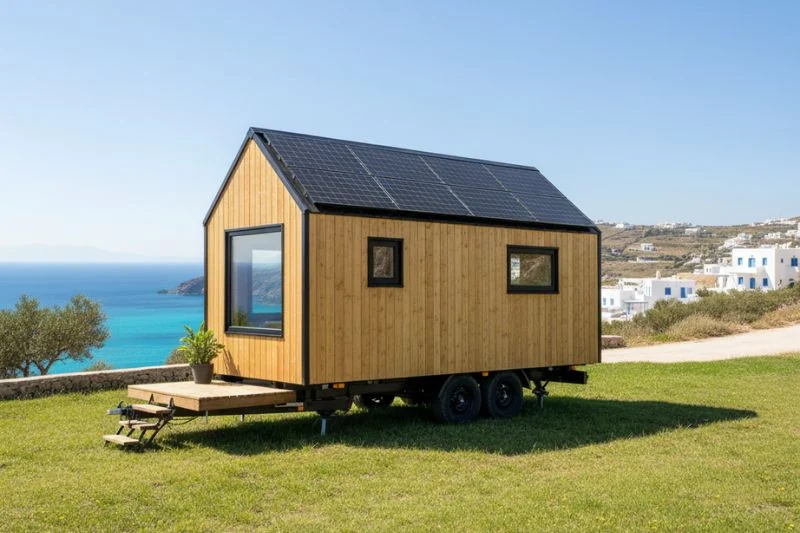
- Energy: solar photovoltaic panels + batteries, generators, or small wind turbines.
- Apă: drilled wells, storage tanks, or rainwater harvesting.
- Wastewater and sewage: septic tanks, composting systems, or small wastewater treatment plants.
- Heating and hot water: wood or LPG stoves, solar thermal panels, or heat pumps.
The difference between off-grid and on-grid is not simply the absence of a utility connection. It also lies in the ability to operate independently and sustainably. Plus, you have greater freedom of movement.
What Is an On-Grid Tiny House?
An on-grid tiny house is connected to the conventional electricity, water, sewage, and gas infrastructure. In practice, it works like any other home, but on a smaller scale.
- Connected to the electricity, water, sewage, and gas networks.
- Advantages: lower initial costs when utility infrastructure is already available in the area.
- Disadvantages: dependence on utility providers; connecting to the grid can be difficult if there is no existing infrastructure nearby; less freedom of movement.
- Utility connection costs vary significantly across Europe and depend on the country, the distance to the existing network, and the infrastructure work required. Connecting electricity, water, sewage, or gas can range from a few hundred euros to several thousand euros, particularly when new infrastructure or long connections are needed.
The main advantage of an on-grid tiny house is predictable comfort. You have a continuous electricity supply, running water, and predictable utility costs, although these are generally higher than with an off-grid setup.
However, you remain dependent on utility providers and public infrastructure .
Can I Have a Hybrid Tiny House That Combines On-Grid and Off-Grid Systems?
Yes. A hybrid tiny house combines the convenience of being connected to public utilities with the autonomy offered by off-grid systems. In our view, this is a highly practical solution for 2026.
Many tiny houses are hybrid: connected to public utility networks while also equipped with photovoltaic panels, rainwater collection systems and/or a composting toilet. This can help reduce running costs while providing a degree of energy and resource independence.
A hybrid tiny house combines on-grid and off-grid features to offer both convenience and partial autonomy, with moderate initial costs and lower utility bills.
How to Choose the Right Option for You in 2026
Ask yourself a few key questions about:
- Location
- Teren izolat -> tiny house off-grid sau hibrid.
- Teren urban/rural cu utilități -> tiny house on-grid sau hibrid.
- Destinația tiny house-ului
- Locuință permanentă -> un tiny house hibrid ar fi ideal.
- Locuință ocazională/ de închiriat -> tiny house off grid sau hibrid, ca să elimini costurile fixe inutile.
- Nivel de confort
- Consum mare de energie electrică (mașini de spălat vase/rufe, espressor, inducție etc.) -> tiny house on-grid sau hibrid.
- Nevoi moderate -> off-grid sau hibrid cu baterii și panouri.
Our recommendation: Before making a purchase decision, discuss all these aspects with us during the planning stage.
This way, you will have a clearer picture of the expected costs, and we can recommend the solutions that best suit your needs and the specific characteristics of your site.
Comparison: On-Grid, Off-Grid and Hybrid Tiny Houses (2026)
| FEATURE | ON-GRID TINY HOUSE | HYBRID TINY HOUSE | OFF-GRID TINY HOUSE |
|---|---|---|---|
| Autonomy | Low – dependent on public utilities | Medium – partial autonomy | Maximum – full autonomy |
| Initial cost | ~34.000 € | 37.500–39.500 € | 40.000–46.000 € |
| Monthly costs | Recurring utility bills | Reduced utility bills | No bills |
| Comfort | Stable and predictable | Stable comfort + partial autonomy | Can be limited (depending on energy consumption) |
| Maintenance | Minimal (utility providers handle the infrastructure) | Partial – public utilities + small private systems | Fully the owner's responsibility |
| Typical scenario | Urban family, looking for stability | People who want comfort + savings + flexibility | Young couple, remote locations, seeking full autonomy |
| Sustainability | Medium | High | Maximum |
Quick FAQ
For many clients, a hybrid tiny house offers a particularly practical combination of comfort, reduced running costs, and greater flexibility over the long term.
Conclusion
- Off-grid, on-grid, or hybrid – all three are viable options when properly planned and adapted to the characteristics of the site and the occupants’ energy and resource needs.
- A hybrid tiny house combines the reliability of public utility networks with the autonomy provided by its own energy systems.
- The expertise of a tiny house specialist is essential when choosing the right configuration for your project.