Heat Recovery Ventilation: What It Is, How It Works, and Why It Is Essential in a Tiny House
Heat recovery ventilation may seem like a minor detail at first glance, but it proves to be essential for comfort, health, and long-term durability.
In a small, airtight space such as a tiny house (but not only), inadequate ventilation means stale air, excessive humidity, mould growth, heat loss, and higher energy bills.
In this article, we explain what heat recovery ventilation is, how it works, and why it is essential for an efficient and healthy tiny house.
What Is Heat Recovery Ventilation?
A heat recovery ventilator (HRV) is a device that provides a controlled exchange of air between the indoors and outdoors, transferring thermal energy from the stale air being extracted to the fresh air being supplied.In other words, a heat recovery ventilator continuously refreshes the air inside the home without significantly lowering the indoor temperature.
A heat recovery ventilator works like the home’s “mechanical lung”: it extracts stale, humid air from inside, brings in fresh air from outdoors, and uses the heat from the outgoing air to warm (or cool, in summer) the incoming air.
How Does a Heat Recovery Ventilation System Work?
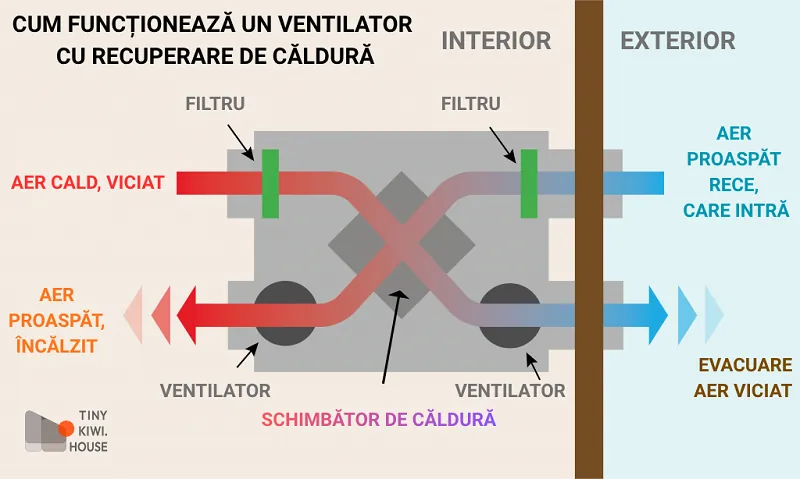
The system consists of two separate air circuits: one that extracts stale indoor air and another that supplies fresh air from outdoors.
Between the two airflows is a heat exchanger, a component that transfers thermal energy without mixing the air, so only the stale air is removed — not the heat from the home.
Thermal efficiency can reach up to 95%, which means minimal energy loss during ventilation.
Direct Benefits of Using a Heat Recovery Ventilator
- consistent thermal comfort, without noticeable temperature fluctuations;
- lower heating costs;
- reduced risk of condensation and mould;
- improved indoor air quality.
Why Heat Recovery Ventilation Is Essential in a Tiny House
The smaller the living space, the faster the air becomes stale — making continuous, controlled ventilation even more important.
In a 20–30 m² tiny house, everyday activities such as cooking, showering, or simply breathing can quickly generate excess moisture.
Studies1 show that an average person can contribute around 1–2.5 L of moisture per day to the indoor environment through breathing, cooking, and showering. This moisture needs to be managed through adequate ventilation to prevent condensation and mould.
The moisture load in a tiny house can be up to ten times higher per unit of volume compared with a conventional home, making controlled ventilation a necessity.In an enclosed space, moisture has nowhere to go — it can accumulate on walls, within the timber structure, and in furniture, eventually affecting both the occupants’ health and the structural integrity of the home.
What Happens Without Heat Recovery Ventilation in a Tiny House
- moisture remains trapped inside and is absorbed by timber, textiles, and furniture;
- condensation, mould spores, and persistent odours can develop;
- the air becomes stale, with increased CO₂ concentrations;
- in winter, opening windows to ventilate the space leads to significant heat loss and higher energy costs.
In humid climates, natural ventilation may not even work effectively: moist air does not circulate efficiently, allowing condensation to remain trapped indoors.
What Happens WITH Heat Recovery Ventilation in a Tiny House
A heat recovery ventilation system removes stale air and excess moisture every 2–3 hours, while simultaneously supplying fresh, oxygen-rich air and minimising heat loss.
The result: clean air, no condensation, and consistent thermal comfort.
This translates into ✅ 35–40% savings on heating costs.
For off-grid tiny houses, these savings mean greater energy autonomy — a smaller, more affordable, and more efficient solar panel system.
Health Benefits: WITH vs. WITHOUT Heat Recovery Ventilation
| With HRV 💚 | Without HRV ❌ |
|---|---|
| ✅ Clean, fresh air | ❌ Stale air with increased CO₂ levels |
| ✅ Deeper sleep, better recovery | ❌ Poor-quality sleep, morning headaches |
| ✅ Better mental clarity | ❌ Fatigue, irritability |
| ✅ Fewer allergy triggers | ❌ Mould spores, dust, and dust mites |
| ✅ Stable indoor environment, no condensation | ❌ Damp walls, structural risk |
Myths and Facts About Heat Recovery Ventilation
💭 Myth: “I can simply open the windows regularly, and that’s enough to prevent mould.”
💡 Fact: In a small, airtight space, you lose heat quickly without ensuring a constant supply of fresh air.
💭 Myth: "Heat recovery ventilation is only for large houses.”
💡 Fact: The smaller the home, the faster the air becomes saturated with moisture and CO₂. The compact size of a tiny house therefore increases the need for controlled ventilation.
💭 Myth: "An HRV system uses too much electricity.”
💡 Fact: Modern HRV systems typically consume 20–80 W — about the same as an LED light bulb — while potentially reducing heating costs by 30–40%.
💭 Myth: “An HRV system is expensive and not worth it.”
💡 Fact: It is an investment that can pay for itself through energy savings, improved comfort, and a healthier indoor environment.
Conclusion: Heat Recovery Ventilation in a Tiny House Is a Necessity, Not a Luxury
Heat recovery ventilation is not a luxury. It is a requirement for healthy and energy-efficient living.
A well-built tiny house, but without a heat recovery ventilation system, can compromise both your comfort and the long-term durability of your home.
🟢 Key takeaway: a tiny house equipped with a heat recovery ventilation system is a smart investment. The air you breathe every day is one of the most important investments you can make in your well-being.
Explore our tiny house models, all equipped with heat recovery ventilation systems.