Tiny House vs. Modular vs. Prefabricated House: Key Differences, Costs and Uses
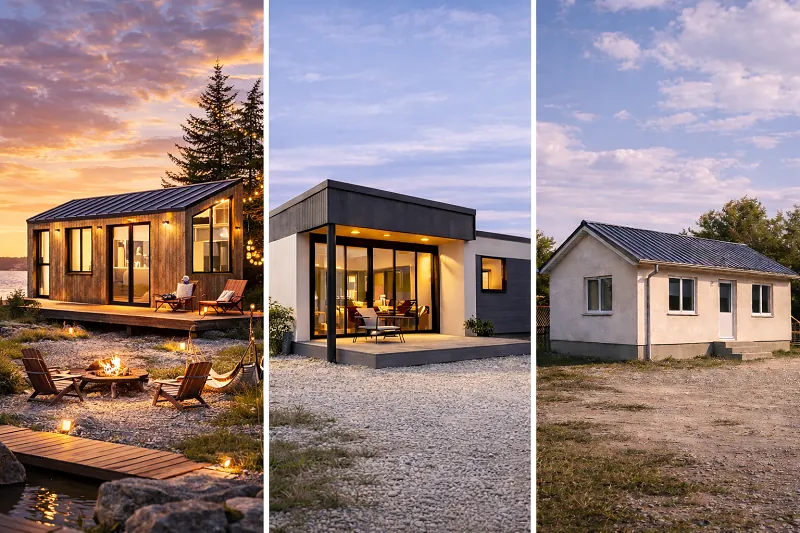
When you start exploring alternatives to traditional construction, three terms quickly come up: tiny house, modular house, and prefabricated house.
The problem is that these terms are often used interchangeably, and sometimes incorrectly. In reality, they refer to quite different things: a construction method, a type of home, or simply the size of the house.
And this is where the confusion begins.
In this article, we’ll take a closer look at the real differences between tiny houses, modular homes, and prefabricated homes: what each term means, how each type is built, and when—and for whom—one option may be a better fit than another.
Tiny House vs. Modular vs. Prefabricated Home: A Quick Overview
In short, these three terms refer to different things.
- tiny house refers to the size of the home and the lifestyle concept behind it.
- modular refers to how the house is designed and built in separate modules.
- prefabricated refers to the method of construction.
That’s why tiny house, prefabricated, and modular aren’t direct alternatives, but concepts that can sometimes overlap.
For example, a modular home is almost always prefabricated, while a tiny house can be modular, prefabricated, or built entirely on-site.
Tiny House – A Brief Definition
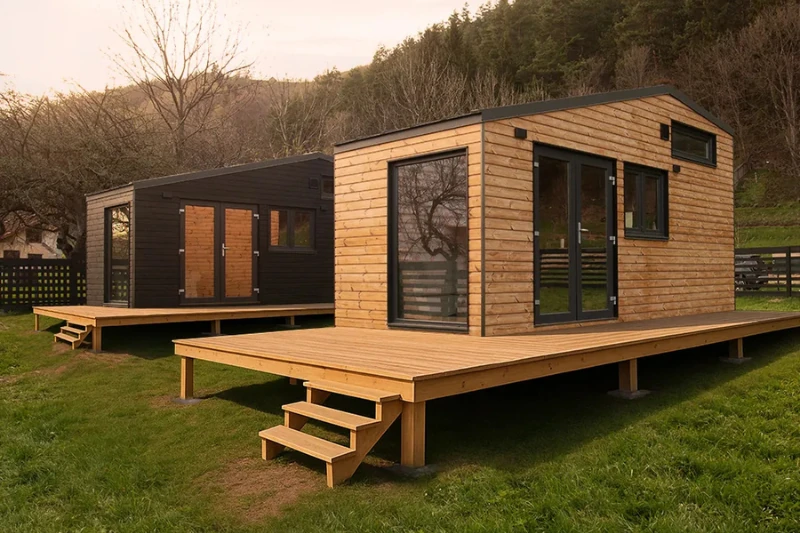
A tiny house is a small home designed to make the most of every square metre.
In most cases, a tiny house ranges from 15 to 40 m², although smaller and larger models are also available. The concept is often associated with a minimalist lifestyle, lower resource consumption, and reduced construction and maintenance costs.
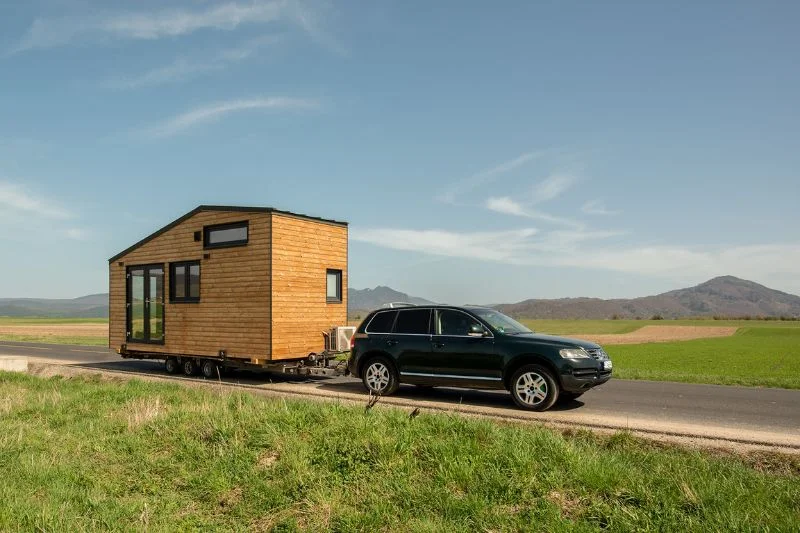
Tiny houses can be mobile or permanently placed. They can be connected to utilities—we call these tiny houses on grid - or they can operate independently as tiny houses off-grid. A hybrid tiny house combines elements of both on-grid and off-grid systems.
Modular House - A Brief Definition
A modular house is made up of three-dimensional modules manufactured in a factory and then transported to the site for assembly.
Each module forms a part of the house—for example, a room or a section of the home—and the modules are then assembled on the foundation to create the complete house.
Modular homes can vary widely in size, from small dwellings to large family homes.
Prefab House - A Brief Definition
A prefab is a house whose main components are manufactured in a factory and then transported to the site for assembly.
Prefabrication can include:
- structural panels
- pre-assembled walls
- floor system components
- volumetric modules
Therefore, “prefabricated” describes the production method, not the shape or size of the house.
Why Are Tiny Houses, Modular and Prefab Often Confused?
The confusion arises because these terms describe different things, but are often used together.
Confusing Construction Type with Manufacturing Method
A tiny house can be built in several ways: prefabricated, modular, or even entirely on-site. By contrast, the term “prefabricated” refers only to how the house components are manufactured.
When these concepts are mixed together, it can seem as though they are directly comparable types of housing.
How These Terms Are Used Incorrectly
In commercial presentations and online articles, these terms are sometimes used more as broad labels than as precise technical definitions.
For example, a small house built in a factory may be described as a tiny house, a modular house, and a prefabricated house at the same time, even though each term refers to a different aspect of the construction.
The Real Differences Between Tiny Houses, Modular and Prefab Houses
Differences in Size
Tiny houses are primarily defined by their small size, typically under 40 m².
Modular and prefabricated houses have no fixed size limit and can be designed as large, permanent residences.
Differences in Construction Technology
A tiny house is not defined by any particular construction technology. It can be built using almost any construction system commonly used for conventional houses, simply adapted to a smaller scale.
The most common construction technologies include:
- timber frame construction
- structural insulated panels (SIPs)
- light-gauge steel framing
For example, at TinyKiwi, we use timber frame construction, with or without a chassis.
Modular houses are built from three-dimensional structural modules manufactured in a factory. Each module is a complete structure that includes walls, flooring, and, in some cases, even the utilities and finishes.
The most commonly used construction technologies include:
- prefabricated timber frame
- light-gauge steel framing
- prefabricated concrete modules (less common in small residential buildings)
The modules are transported to the site and assembled on the foundation to form the finished house.
A prefabricated house is any house whose components are manufactured in a factory before being assembled on site.
The construction technologies can vary widely and include:
- prefabricated structural panels (timber frame or SIPs)
- prefabricated concrete modules
- prefab volumetric modules
Depending on the system used, the structure is simply assembled on site rather than built there from scratch.
Differences in Use
Tiny houses are commonly used for:
- vacation houses
- tourism projects
- a minimalist lifestyle
Modular and prefabricated houses are often used as permanent residences, but they can also be used for tourism or commercial projects.
Tiny House vs. Modular vs. Prefabricated House: A Comparison Table
| Feature | TINY HOUSE | MODULAR | PREFAB |
| typical size | 15–40 m² | may vary | may vary |
| use | vacation, minimalist lifestyle | permanent residence | may vary |
| materials | wood, metal | may vary | may vary |
| estimated lifespan | comparable to timber-frame conventional house | comparable to conventional house | depends on the system |
| mobility | fixed or mobile | fixed | fixed |
| construction time | 2 months or less | 2-5 months | 3-6 months |
| ideal for | couples, tourism, families 2-4 members | families, singles, couples | may vary |
| estimated cost | starting from EUR 32,000 | starting from EUR 60,000 | EUR 20-100,000 |
Conclusion
A tiny house, a modular house, and a prefabricated house are not the same thing.
A tiny house describes the size and lifestyle concept, while modular and prefabricated describe ways of building a house.
Understanding these differences makes it easier to choose the right type of house based on available space, budget, and how the house will be used.
Get in touch with us with any questions about tiny houses.